
Yields just Hit Their Highest Level Since 2007 – Here’s What That Means for Your Bonds
By Brent Gargano, CFP®
September 2026 | Infinite Wealth Planning
When people think about market volatility, they usually look at stocks. And that’s useful. But if we’re only looking at the stock market, we’re missing an important part of the story. Lately, the real action has been in the bond market.
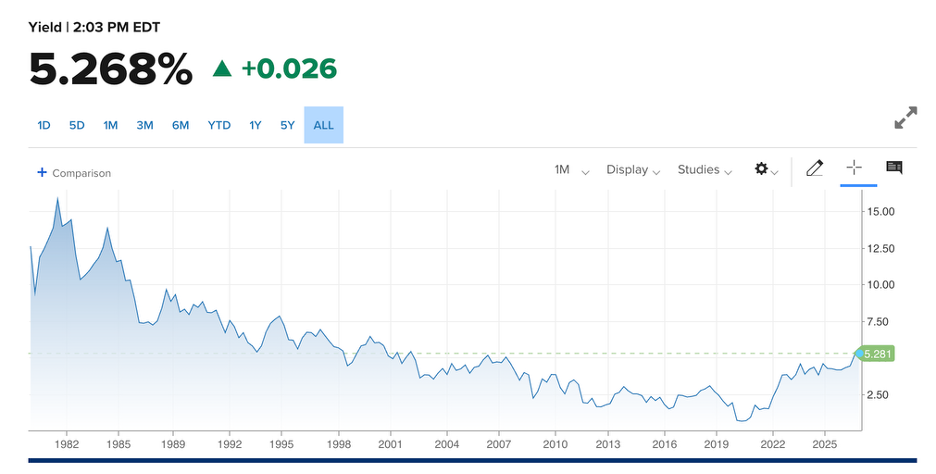
Over the past three months, the interest rate on a 10-year U.S. Treasury bond has gone from 4.36% all the way up to about 5.27% as of this writing, the highest level since 2007.
A stock is ownership, a bond is a loan
Owning stock means owning a piece of a company. If the company grows in value, your share may become more valuable. If the company goes to zero, the value of your share may go with it.
Buying a bond means lending money with a promise to be repaid. The bond has terms, including an interest rate and a repayment date. That gives the lender more certainty about the payments they’re supposed to receive, but it also limits their upside if the company grows dramatically.
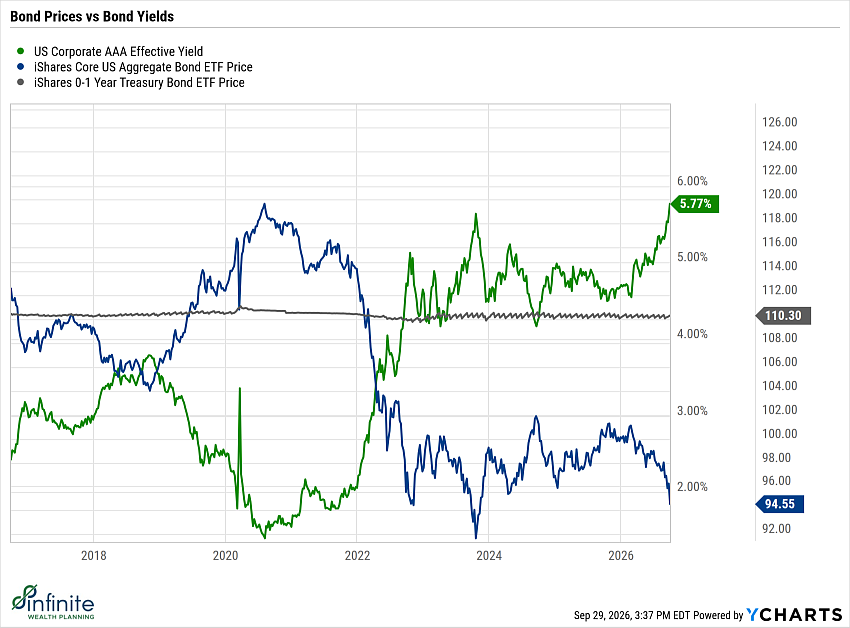
The value of a bond can still change between the day it’s issued and the day it comes due. One reason is interest rates. When market rates rise, new bonds offer higher yields. An existing bond paying a lower rate may have to sell for less to compete. That’s why bond prices and interest rates generally move in opposite directions. And, in general, the longer the time until a bond matures, the more sensitive its price is to interest-rate changes.
That’s exactly what happened this quarter. As yields climbed, the prices of existing bonds fell. Most of the bonds we own in client portfolios are short-term, and that’s on purpose. These
shorter-term bonds are less sensitive to interest rate swings, providing some protection against rate volatility.
What’s pushing yields higher?
A common misconception is that the Fed has control over all interest rates. In fact, the Fed directly sets only the overnight lending rate, which is short-term and doesn’t always move longer-term rates. Longer-term rates are set by the market and respond to the broader economy. Right now, there are several forces pushing rates higher:
· Higher inflation expectations. If investors think inflation will stay higher for longer, they generally want more interest to make up for the purchasing power they expect to lose. Oil is back above $100 a barrel, up more than 50% from a year ago, and inflation expectations are following along.
· Growth and demand for capital. A strong economy can mean more businesses want to borrow and invest. Large technology companies, for example, have been borrowing to fund investments like data centers and AI infrastructure. When demand for borrowing rises, the cost of borrowing can rise too.
· Government borrowing. Gross U.S. debt passed $40 trillion in August, according to U.S. Treasury data. The amount of Treasury debt the government needs to issue, and the
questions investors have about the long-term fiscal outlook, can affect the yields investors demand.
What does it mean for your portfolio?
There is some good news here. Higher yields mean that new money going into bonds can earn more interest than it could when rates were lower. As short-term bonds mature, or as cash becomes available to reinvest, investors can put that money to work at today’s higher yields. The Fed just raised its rate as well, so short-term yields are climbing too, and short-term bonds like the ones we favor reset to those higher yields quickly.
Still, higher yields don’t make bonds a complete answer. Bonds carry a risk that’s easy to overlook: inflation.
When playing it safe isn’t so safe
Many of our clients who consider themselves to be conservative investors also name inflation as a top concern. There is some irony in that. Avoiding stocks can feel like the safe choice, but it can leave you more exposed to the very thing you’re worried about. Bonds are good at limiting short-term swings, but inflation can eat away at most or all of their return. Stocks represent ownership in a company’s earnings, which have tended to grow with inflation over time as companies raise prices. The trade-off is bigger short-term swings along the way.
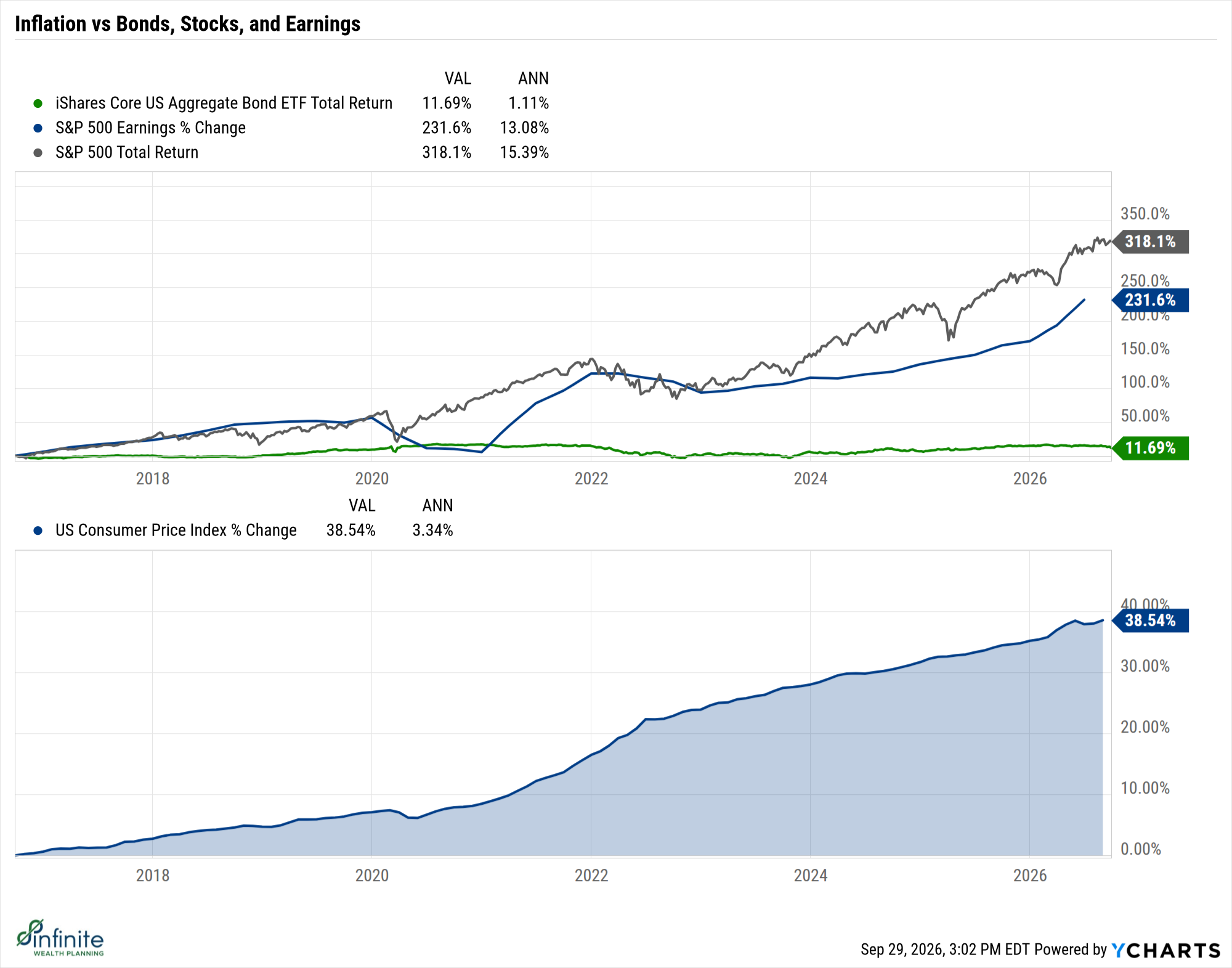
The chart below shows what that looked like over the last 10 years. In that time, inflation (CPI) rose about 38% in total, or about 3.34%/year. Over that same period, the S&P 500 returned about 318% including dividends, with S&P 500 earnings also up about 231%. The broad U.S. bond market (represented by the iShares Core U.S. Aggregate Bond ETF) returned about 11.7%, or 1.11%/year. After inflation, that’s a loss of roughly a fifth of its purchasing power.
What you can do right now
Higher rates cut both ways, and a few quick checks can put them to work for you:
· Look at your cash. Many bank accounts still pay very little, while money market funds and Treasury bills pay much more. Money sitting in checking or savings may be earning far less than it could.
· Don’t rush to pay off cheap debt. If you locked in a low fixed rate on your mortgage, you may come out ahead by keeping that loan and earning more on your savings, even after taxes.
· Pay attention to variable-rate debt. Credit cards, home equity lines, and adjustable-rate loans get more expensive as rates rise. Depending on their rates, it could make sense to pay those down.
Different investments, different jobs
No one investment is designed to address every risk. Bonds can provide income, liquidity, and relative stability for money that may be needed sooner. Stocks and other growth assets can help support longer-term goals and purchasing power. The right mix depends on what the money needs to do and when it may be needed.
If you’re wondering what role the bonds or cash in your plan are playing—or whether your portfolio is set up for an upcoming change or distribution—please reach out. You don’t need to have a polished question ready. And if we haven’t connected in a while, or you feel like you need more attention, tell us. We want to make sure we’re talking about what’s happening in your life and that you’re getting the planning support you need. You can schedule time with us anytime at infinitewealthplanning.net.
Schedule Your Year-End Planning Session Below


Thanks For Reading! We Hope To See You Again!
Brent Gargano, CFP®
Founder and Financial Advisor of Infinite Wealth Planning
For More Updates:

This content is for informational purposes only and does not constitute investment advice. Past performance is not indicative of future results. Please consult with a qualified financial advisor before making any investment decisions. Brent Gargano, CFP® is the founder of Infinite Wealth Planning. Advisory services offered through National Wealth Management Group.
Advisory services offered through National Wealth Management Group, LLC, a Registered Investment Adviser. This information is intended for educational purposes and is not intended as a recommendation to buy or sell securities. Investing involves risk. Before investing, you should consult with a financial advisor to determine how a specific investment strategy fits your personal goals and objectives.
