

College Savings Strategies for Every Stage of Your Family’s Journey
By Brent Gargano, CFP®
July 2026 | Infinite Wealth Planning
It’s back-to-school season! In our house, we are looking forward to the beginning of the new school year and getting back to a normal routine. As for our family, education is a huge priority.
Advisors have ongoing conversations about whether the money we spend on education is “worth it”, but I don’t think you can actually put a dollar figure on what we’re trying to give our kids. For us, it’s not really about setting them up to make money or hit some career milestone. It’s about giving them the best shot at making sound, thoughtful decisions for the rest of their life — and it’s also about showing them how much we value them by making their college education a priority.
Similarly, one of the most frequent goals for our clients in retirement is to find ways to support their children and grandchildren to help them live a better life. Over the past years, we’ve helped clients confidently use millions of dollars to help their children be educated, have stable housing, and raise families. We love when the resources that have accumulated through thoughtful planning and investing is converted into a life well lived, however the client defines that. Education is one of our favorites because it builds a capability that stays with someone for life — the difference between a handout and a leg up.
Here’s a bit more on how we help clients in each stage of life as they navigate education savings:
Just getting started
If you’re a new parent, college feels impossibly far away, which is exactly why it’s the best time to start. Compound interest needs time to take over.
Consider this: assuming someone saved $8k/year annually starting when their child is born and continuing through age 18, 80% of the investment returns are achieved in the last 9 years of the savings journey. Time matters!

Today, the average total cost (tuition, fees, room, and board) for a four-year, in-state public university runs around $31,000 a year. Using a college cost growth assumption of 5.5% a year — a long-term planning assumption from JPMorgan Asset Management- that $31,000 freshman year alone could run roughly $81,000 by the time a child born today enrolls. And that’s just year one; costs keep climbing through sophomore, junior, and senior year, for a total that can be in the hundreds of thousands of dollars.
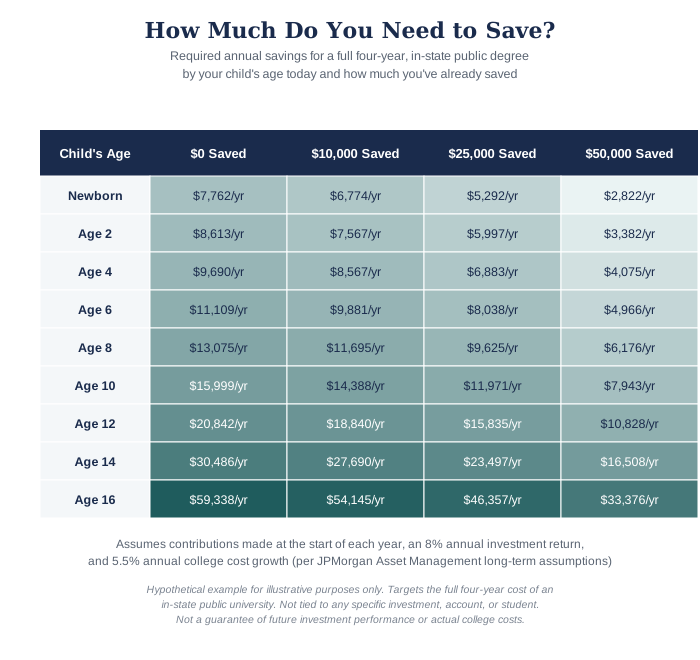
The good news: this is very fundable if you start early. Start early enough, and compound interest does most of the heavy lifting; your money ends up doing the work instead of you. Here’s what it takes, depending on your child’s age today and how much you’ve already saved — assuming an 8% annual investment return and college costs continuing to grow at 5.5% a year, and targeting a full four-year, in-state public degree:
A 529 plan is the standard vehicle for this: contributions grow tax-free, and withdrawals are tax-free when used for qualified education expenses. Many states also offer a tax deduction or credit for contributing to save even more money.
Worried about locking money away you might not need?
One of the most common reasons we see clients avoid funding 529’s is concern around not being able to use the money for college. Some children get scholarships and don’t end up needing the funds, they might go into the military or trade school or not go to college at all. It’s a real concern, but 529s have gotten a lot more flexible in recent years. Here are a few things you should know about how you can access the funds outside of college:
- K-12 tuition: as of 2026, you can withdraw up to $20,000 per year, per child, tax-free for private K-12 tuition — double the old $10,000 limit. Not every state has adopted the higher limit yet, so check before assuming it applies to your state taxes too.
- It’s not just for four-year degrees: 529 funds already cover trade schools, vocational programs, and registered apprenticeships (tools, fees, books included) — and as of 2026, a new law expanded that further to include standalone credentialing programs like welding certification, HVAC licensing, and CDL training, even ones that don’t participate in federal financial aid.
- Roll it into a Roth IRA: if there’s money left over, you can roll up to $35,000 over a lifetime from a 529 into a Roth IRA for the same beneficiary — as long as the account has been open at least 15 years, the funds being moved are at least 5 years old, and the rollover stays within that year’s Roth IRA contribution limit.
- More penalty-free exits than most people expect: scholarships, attending a U.S. military academy, and a few other specific situations all let you withdraw a matching amount without the usual 10% penalty (you’d still owe income tax on the earnings, just not the penalty).
- You can always redirect the money: if the original beneficiary doesn’t need it, you can change the beneficiary to another qualifying family member — a sibling, a cousin, even yourself — with no tax or penalty at all.
College Planning Goes Beyond Just Saving
By the time college is a year or two away, it’s easy to feel buried — dozens of schools, no clear sense of real cost, aid packages that seem to come out of nowhere. A lot of families just start applying somewhere and figure it out later. That’s usually an expensive way to do it. Saving the money is only half the equation — being strategic about which schools you’re applying to, and why, is just as important as how much you’ve saved.
Two things matter most at this stage:
- File the FAFSA as soon as it opens. The FAFSA for the 2027-28 school year is set to open October 1, 2026. The earlier you file, the better positioned you are, since some aid is first-come, first-served.
-
Know the difference between need-based and merit-based aid. The FAFSA is how schools determine your eligibility for need-based aid — grants, subsidized loans, work-study — based on what’s called your Student Aid Index. Merit aid is separate: it’s awarded based on academic or talent achievement, not financial need, and some of it doesn’t require a FAFSA at all. Most families end up with some combination of both, which is exactly why it’s worth understanding rather than assuming one or the other.
- Understand your real, net cost at each school before your student falls in love with one. Here’s the part that surprises people: every school calculates your Student Aid Index a little differently, and each has its own cost of attendance and its own aid budget. That means the same family, applying to five different schools, can end up with five very different net prices — sometimes with the “expensive” school actually costing less out of pocket than the “affordable” one. Sticker price and actual price are rarely the same number. Net price calculators and tools — College Aid Pro is one option worth researching — can help you estimate real, school-by-school pricing before applications go out.
Grandparents: looking to help the next generation
If you’re a grandparent looking for a meaningful way to help, a 529 plan is one of the most powerful tools available. You can open one yourself with your grandchild as the beneficiary — which lets you keep control of the account and change the beneficiary later if plans change. Or, if you’re comfortable giving your kids more say, you can simply give them money to add to a 529 they’ve already opened for their own children. Either way, it’s a gift that keeps compounding long after it’s given.
Wherever you’re starting from
Whether you’re just getting started, worried about oversaving, navigating financial aid, or looking for a meaningful way to help as a grandparent — this is exactly the kind of planning conversation we enjoy having. Schedule a time to talk and let’s figure out where your family stands.
Ready to talk through what this means for your situation?


Thanks For Reading! We Hope To See You Again!
Brent Gargano, CFP®
Founder and Financial Advisor of Infinite Wealth Planning
For More Updates:

This content is for informational purposes only and does not constitute investment advice. Past performance is not indicative of future results. Please consult with a qualified financial advisor before making any investment decisions. Brent Gargano, CFP® is the founder of Infinite Wealth Planning. Advisory services offered through National Wealth Management Group.
Advisory services offered through National Wealth Management Group, LLC, a Registered Investment Adviser. This information is intended for educational purposes and is not intended as a recommendation to buy or sell securities. Investing involves risk. Before investing, you should consult with a financial advisor to determine how a specific investment strategy fits your personal goals and objectives.
