
When AI Is So Good… It Might Be Bad?
Since last fall, we’ve seen a noticeable shift in markets. The “AI trade” that felt almost unstoppable since 2023 has begun to cool off. The “Magnificent Seven” stocks are nearly flat over the past six months, and other speculative assets like cryptocurrencies have fallen significantly from their highs. Software stocks have taken a significant hit as a group down nearly 30% since mid-October.
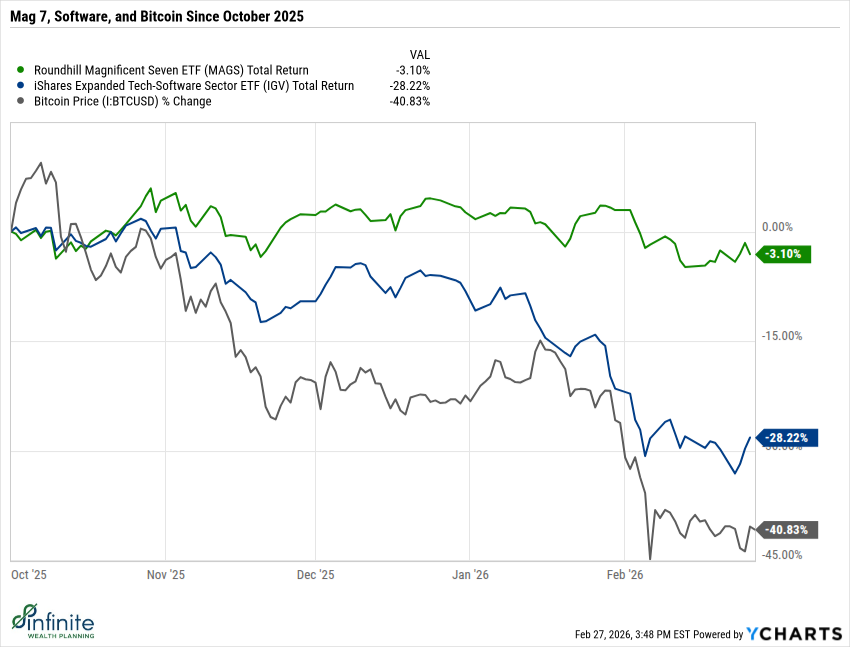
That doesn’t mean the AI story is over, but it does mean the narrative is evolving.
Over the past few years, investors rewarded anything connected to AI infrastructure or AI-enabled software. Expectations were enormous. In many cases, markets priced in not only strong demand, but the assumption that existing business models would remain untouched.
Now investors are starting to ask a more nuanced question: if AI can build, automate, analyze, and create at scale, what does that mean for the companies that currently sell the tools to do those things?
In my own industry, for example, we pay for financial planning software to build projections and run scenarios. But it’s not hard to imagine a future where AI can generate a full financial model instantly without traditional software. Zoom that out to a larger scale. If AI can manage databases, write code, or automate workflows, what happens to some of the software platforms that power those tasks today?
This is where the market tension lies. AI may be transformative, but its power could pressure the very companies that helped enable it. That uncertainty is creating volatility, particularly in higher-multiple growth and software stocks.
The good news is that this is exactly why we build diversified portfolios.
While speculative pockets have pulled back, broader leadership has quietly rotated. Mid-cap stocks have participated more. International markets, after years of lagging, have outperformed recently. Value-oriented sectors have contributed. As a result, many clients’ diversified portfolios are at or near all-time highs.
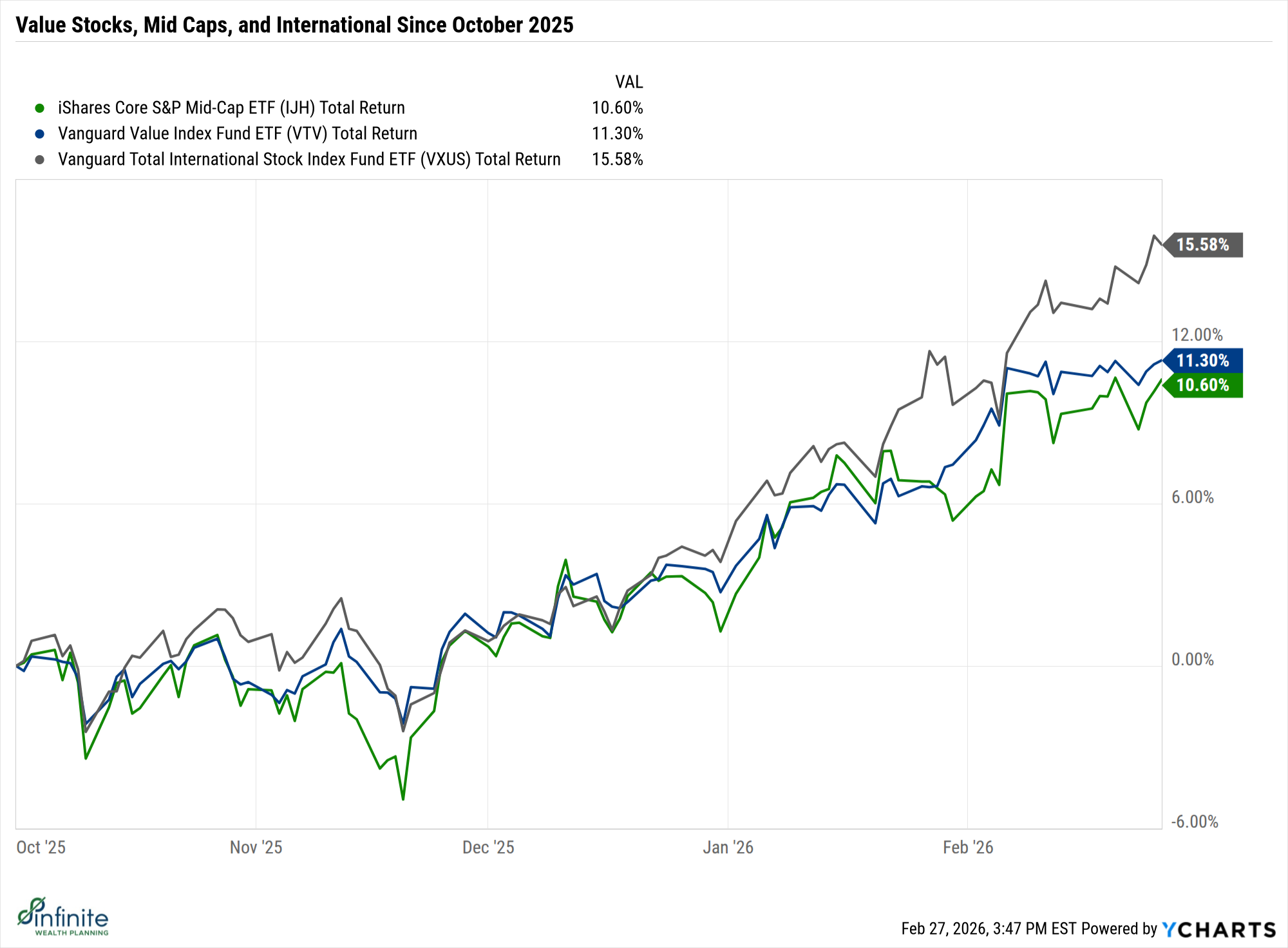
This is how healthy markets function. Leadership rarely stays concentrated forever. It rotates. And when portfolios are properly diversified, we don’t need to predict that rotation in advance — we participate in it.
Our job is not to guess which pocket of the market will win next year. Our job is to build resilient portfolios that can adapt to changing leadership without requiring constant repositioning. Right now, that discipline is being rewarded.
As markets continue to figure out what AI truly means for profits, margins, and business models, we should expect continued volatility. That’s normal. What matters is that your portfolio isn’t dependent on any single theme, trend, or narrative to succeed.
If anything, this period is simply a reminder that diversification remains a cornerstone of a properly built portfolio… It may not always feel exciting — but over time, it works.
February Resource – What Forms You Need For 2025 Taxes



Thanks For Reading! We Hope To See You Again!
For More Updates:

Advisory services offered through National Wealth Management Group, LLC, a Registered Investment Adviser. This information is intended for educational purposes and is not intended as a recommendation to buy or sell securities. Investing involves risk. Before investing, you should consult with a financial advisor to determine how a specific investment strategy fits your personal goals and objectives.