A Recap of 2025 and looking to 2026
It’s hard to believe that 2025 is almost over, and even harder to believe that it’s been nearly five years since the COVID pandemic. Reflecting on my own life, it’s amazing to see how much has changed in that time, and I know the same is true for many of you. More often these days, I’m reminded that the days are long and the years are short. Maintaining a long-term view that keeps things moving in the right direction is much easier when looking backwards than it is in the moment, especially when markets are volatile and headlines are loud.
2025 was a good example of this.
The year started off with a bang as Donald Trump once again took office as President and quickly got to work on his political agenda. For markets, all eyes were on the anticipated tariff policy set to be released on “Liberation Day,” with wide speculation about what the rates might be. Once the plan was announced, markets were sent into a downward spiral, bottoming out at more than a 20% decline from their peak just two months earlier.
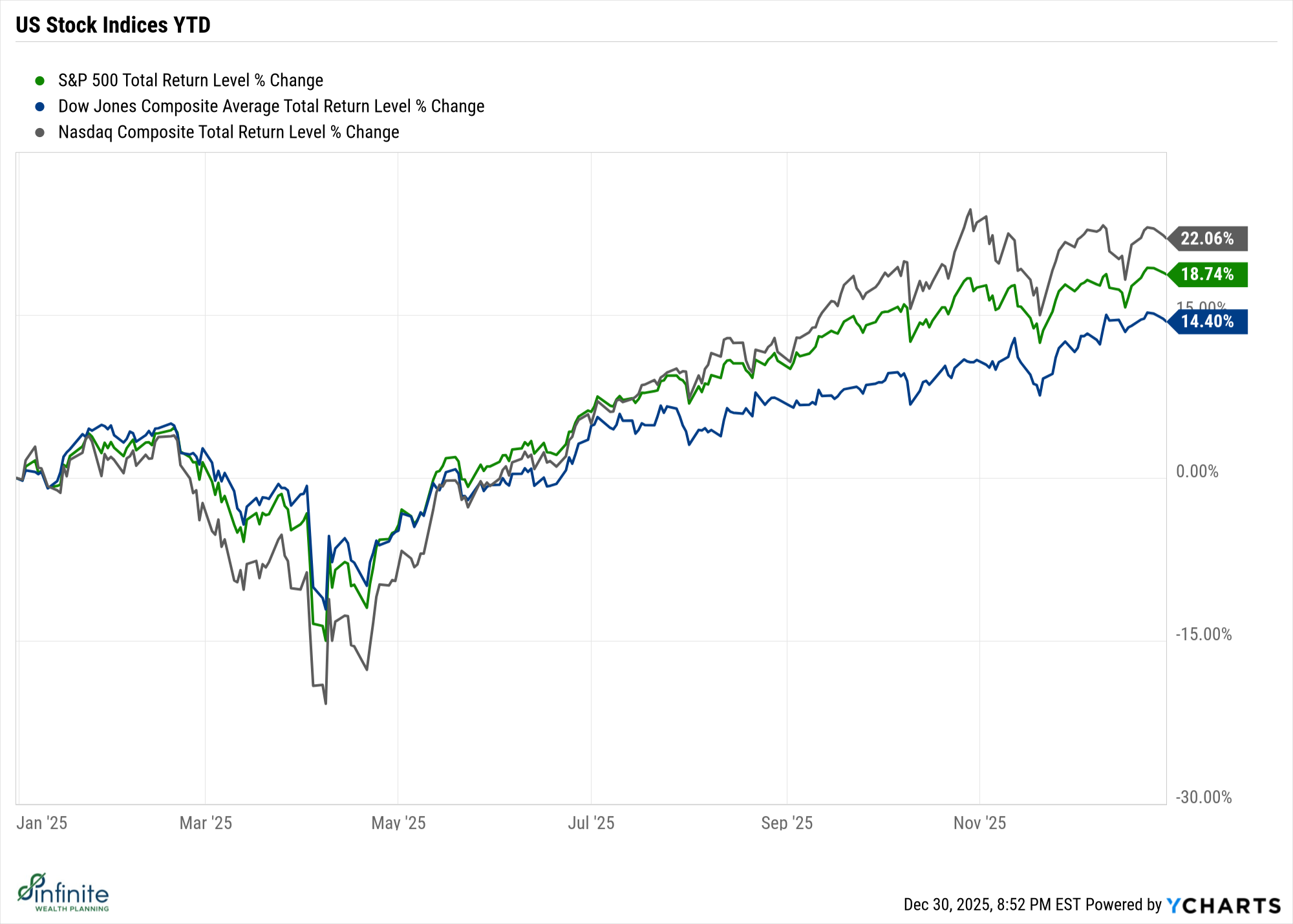
While it’s never fun to watch markets sink, it’s important to put these moves into context and maintain a long-term perspective. That approach paid off in a relatively short period of time, with markets rallying back to their highs by mid-summer and finishing the year up more than 18% on the S&P 500.
Along the way, we saw several important developments for investors.
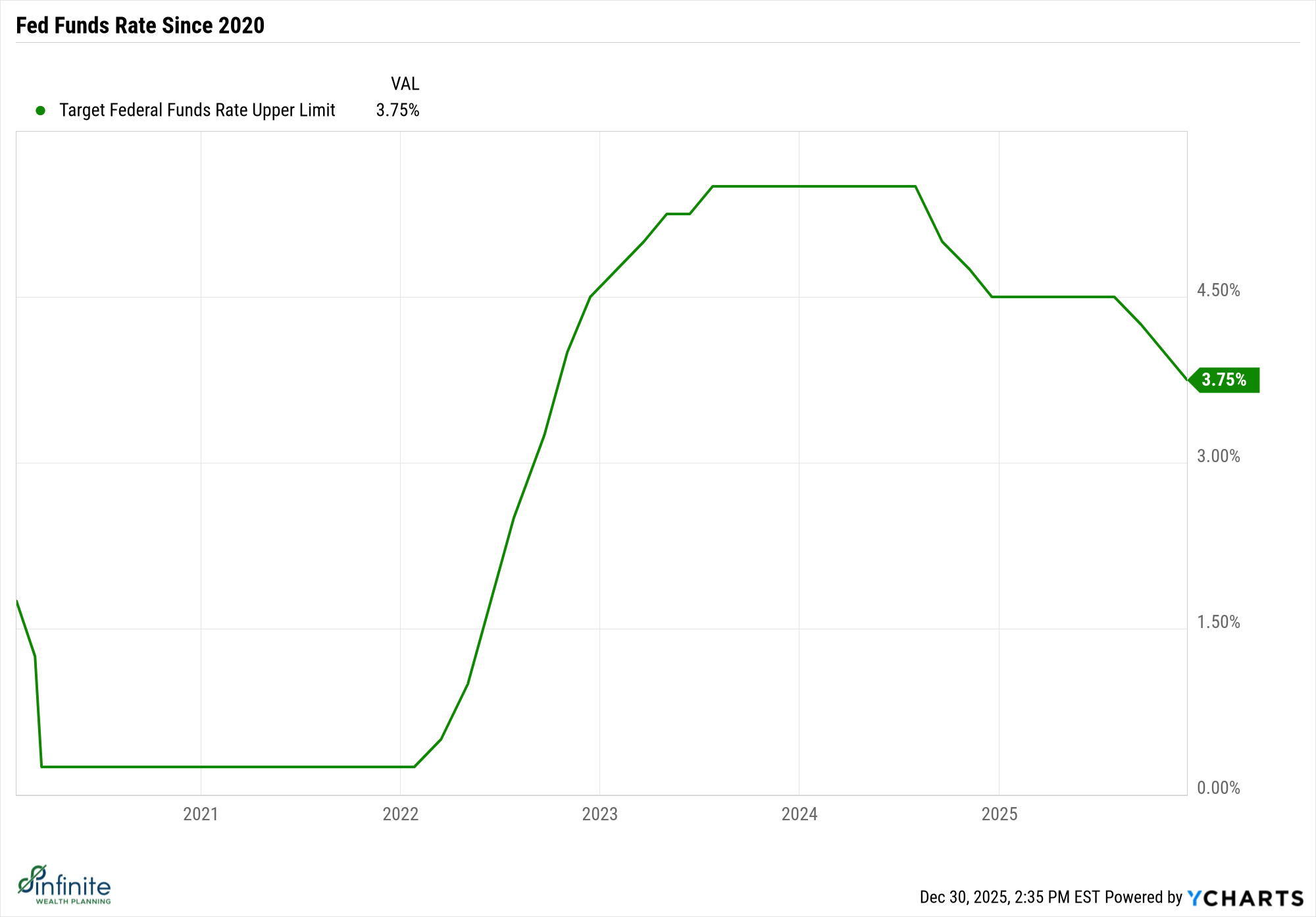
One notable storyline in 2025 was the relationship between Donald Trump and Jerome Powell, the current Chair of the Federal Reserve. While President Trump has been vocal about wanting interest rates lower, Powell and the Fed remained cautious amid concerns about lingering inflationary pressures. Ultimately, the Fed cut short-term interest rates by roughly 0.75% this year.
Unfortunately, longer-term interest rates remained elevated, keeping mortgage rates relatively sticky around 6%. President Trump has publicly expressed frustration with Powell and has floated the idea of removing him, but has been unable to do so — underscoring the independence of the Federal Reserve. With Powell’s term set to expire in May, we will be closely watching who is appointed as the next Fed Chair and what that could mean for policy moving forward.
Last summer, the “One Big Beautiful Bill Act” was passed in July, extending the tax cuts originally enacted in 2017 indefinitely. The legislation also expanded several tax provisions, including increasing the cap on state and local tax deductions from $10,000 to $40,000 per year (for those under certain income thresholds), restoring 100% bonus depreciation for business owners, and making permanent the estate tax exemption of $15 million per person.
While these developments were generally welcomed by investors, October brought the longest government shutdown in U.S. history. Government shutdowns tend to create significant concern for clients and retail investors but historically have had little lasting impact on markets. This proved true once again, with the S&P 500 rising roughly 2% over the course of the shutdown.
Of all these developments, our focus remains squarely on the economy and Federal Reserve policy. The economy has continued to run hot, with recent GDP data showing strong inflation-adjusted growth north of 4%, driven in part by higher productivity. At the same time, inflation has shown signs of cooling as productivity improves, housing costs begin to level off, and oil prices decline.


That said, unemployment has started to tick higher, raising questions about the strength of the U.S. consumer — the backbone of the economy.

As we look ahead to 2026, we expect markets to continue to “climb a wall of worry” as investors navigate several key catalysts. Early in the year, Congress will need to address the federal budget once again, raising the possibility of another government shutdown. In April, we’ll begin to see more of the real-world impact of the new tax legislation, followed by the appointment of a new Fed Chair in May and mid-term elections later in the year.
We also expect the conversation around artificial intelligence to continue. While large growth and technology stocks have outperformed over the past five years, fueled by both the accelerated technology adoption during the COVID era and the rapid expansion of AI, it will be important for these investments to ultimately translate into higher productivity and profitability. If that does not materialize, some AI-related companies could face pressure after significant infrastructure spending predicated on strong future demand.
For investors who have become over-concentrated in large technology stocks, this reinforces the importance of rebalancing to ensure participation across other areas of the market. Value stocks, small-cap companies, and international markets have lagged in recent years and may provide diversification benefits if leadership in the market shifts.
One of the key benefits of a diversified portfolio is that there will always be areas you feel good about, and others that are temporarily out of favor. That balance helps investors stay disciplined through market cycles.
As always, please let us know if you’d like to review your plan or have any questions as we head into the beginning of 2026. It is truly our pleasure to serve you.
If you have questions about how these concepts fit into your financial plan, please reach out.

Thanks For Reading! We Hope To See You Again!
For More Updates:

Advisory services offered through National Wealth Management Group, LLC, a Registered Investment Adviser. This information is intended for educational purposes and is not intended as a recommendation to buy or sell securities. Investing involves risk. Before investing, you should consult with a financial advisor to determine how a specific investment strategy fits your personal goals and objectives.